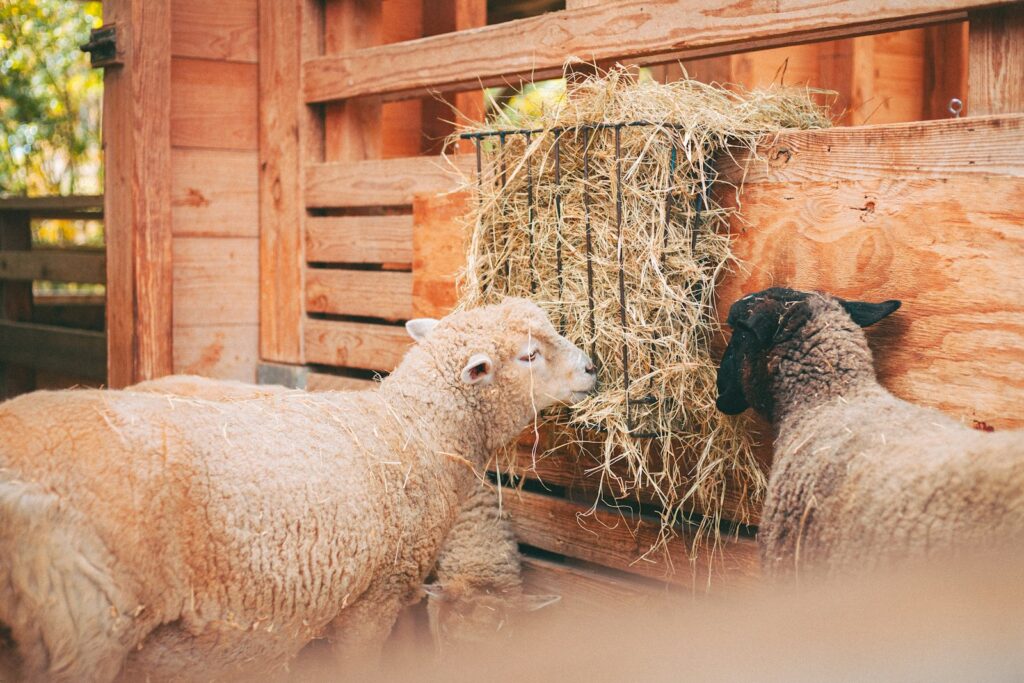
An adult sheep eats about 2 to 3% of its body weight in dry feed every day, so a 50 kg ewe needs roughly 1 to 1.5 kg of dry matter. Pregnant, lactating and fattening sheep eat more, often 3 to 4% of body weight. Most of that should be hay or forage, with concentrate feed added to fill the gap the forage can’t cover.
That is the short answer to how much feed does a sheep eat per day. The useful answer depends on the sheep’s weight, its stage of life, what the hay is like and how hot it is. A dry ewe resting in the shade in January has very different needs to a ram lamb you’re pushing for Eid. This guide gives you the numbers and a simple way to work out a daily ration for your own flock, whether you run a large farm or a small ezba.
Quick answer: Plan on 2 to 3% of body weight a day in dry feed for adult sheep, and 3 to 4% for lactating ewes and growing lambs. For a 50 kg ewe on maintenance that is about 1 to 1.5 kg, mostly hay, plus 0.25 to 0.5 kg of concentrate. Always provide clean water and split feed into two or more meals.
How much feed does a sheep eat per day by body weight?
Feed advice is based on dry matter, which is the feed left once the water is taken out. Hay and pellets are about 88 to 92% dry matter, so 1 kg of hay or bagged feed is close to 0.9 kg of dry matter. Fresh green fodder is a different story: fresh alfalfa or Rhodes grass can be 75 to 85% water, so a sheep has to eat several kilograms of it to get the same nutrition as 1 kg of hay.
Here is a rough guide for adult sheep on maintenance, meaning they aren’t pregnant, milking or being fattened:
| Body weight | Dry matter a day (2 to 3%) | Typical hay | Typical concentrate |
|---|---|---|---|
| 30 kg | 0.6 to 0.9 kg | 0.5 to 0.8 kg | 0.1 to 0.25 kg |
| 40 kg | 0.8 to 1.2 kg | 0.7 to 1 kg | 0.2 to 0.3 kg |
| 50 kg | 1 to 1.5 kg | 0.9 to 1.2 kg | 0.25 to 0.4 kg |
| 60 kg | 1.2 to 1.8 kg | 1 to 1.4 kg | 0.3 to 0.5 kg |
| 80 kg | 1.6 to 2.4 kg | 1.3 to 1.8 kg | 0.4 to 0.6 kg |
These are starting points. Good alfalfa needs less concentrate on top. Poor, stalky Rhodes grass hay needs more. Watch the animals and adjust.
Feed needs change with the stage of life
Needs jump most in late pregnancy and early lactation.
- Dry ewes and mature rams out of season: 2 to 2.5% of body weight. Good hay alone can be close to enough, with a small amount of concentrate.
- Late pregnancy (last 6 weeks): energy needs rise sharply, but the lamb takes up space in the belly, so the ewe can’t eat much more bulk. This is when a denser concentrate earns its place. Underfed ewes at this stage are at risk of pregnancy toxaemia.
- Lactating ewes: 3 to 4% of body weight, more if she’s suckling twins. Protein matters here as much as energy.
- Growing and fattening lambs: 3 to 4% of body weight, with a higher share of concentrate. See our guide on the best feed for fattening sheep for detail.
- Rams before breeding: lift their feeding for a few weeks before joining so they’re in good condition, without making them fat.
For a pregnant or milking ewe, a feed with more protein, such as Balanced Feed at 12%, is usually a better fit than a basic maintenance feed.
Hay first, concentrate second
Sheep are ruminants. Their rumen needs long fibre to work properly, and a diet that is mostly grain or pellets with little roughage can lead to acidosis, bloat and other digestive trouble. As a general rule, forage should make up at least half of what an adult sheep eats, and often much more for animals on maintenance.
In the UAE, most flocks run on Rhodes grass hay, alfalfa or a mix of both. Rhodes grass is cheaper and usually sits around 7 to 10% crude protein. Alfalfa is richer, often 15 to 20%. A flock on Rhodes grass will usually need a protein boost from concentrate. A flock on good alfalfa may need very little.
Concentrate covers the gap. For everyday feeding of adult sheep and goats, an economy feed like Long Reach Sheep Feed at 10% protein works alongside hay. Introduce any new concentrate slowly over 7 to 10 days so the rumen microbes can adjust.
Water: the part people forget
A sheep can’t eat well if it isn’t drinking well. In mild weather an adult sheep drinks roughly 4 to 6 litres a day. In UAE summer heat that can double, and a lactating ewe may drink 10 litres or more. Sheep on dry hay and pellets drink more than sheep on fresh green fodder.
- Keep troughs in the shade so the water stays cool.
- Clean troughs every day or two. Sheep will drink less from dirty or warm water.
- Check float valves and pipes daily in summer.
- Provide a salt or mineral lick unless your concentrate already covers minerals.
Feeding sheep in UAE summer heat
Heat cuts appetite. In July and August many sheep eat 10 to 20% less than they do in winter, and they eat less during the hottest hours. You can work with that instead of fighting it.
- Feed early in the morning and again in the evening, when it’s cooler.
- Give the bulk of the hay in the evening. Digesting fibre produces heat, and the night is when the animal can cope best with that.
- Because they eat less, make each kilogram count. A slightly denser ration helps keep intake of energy and protein up.
- Don’t make sudden changes to the diet in peak summer. Stressed animals handle change badly.
Our article on heat stress in livestock covers this in more depth, and our feeds page lists every Long Reach bagged feed.
How to work out a daily ration for your flock
A scale and a notebook are enough.
- Estimate weight. Weigh a few typical animals if you can, or use a weigh band. Guessing by eye is often 10 to 20% out.
- Pick a percentage. Use 2 to 2.5% for maintenance, 3% for late pregnancy and growing stock, and 3 to 4% for milking ewes and fattening lambs.
- Multiply. 50 kg × 2.5% = 1.25 kg dry feed a day.
- Split it. For a maintenance ewe, about 75 to 85% hay and 15 to 25% concentrate. For fattening lambs, the concentrate share rises.
- Weigh the feed for a week. Use the same bucket or scoop and weigh what it holds. Then you can feed by the scoop.
- Watch leftovers and condition. If they clear everything fast and look thin, feed more. If a lot is left and they’re getting fat, feed less.
The feeding guide printed on Long Reach bags follows the same logic: 2 to 3% of body weight a day for adult livestock, more for growing or lactating animals, split over several feedings, with forage or hay alongside.
For specific rations, especially for pregnant ewes or large fattening groups, talk to a vet or livestock nutritionist. They can check your hay quality and body condition and fine tune the numbers.
Signs you are feeding too much or too little
Body condition scoring is the best check. Feel along the backbone and the loin behind the last rib. On a thin sheep the spine is sharp and you can feel each bone. On a fat sheep you can barely find it.
- Underfed: sharp spine, dull wool or coat, slow growth, low milk, lambs that don’t thrive, ewes that don’t come into season.
- Overfed: fat over the loin, wasted feed, lower fertility in ewes, more lambing trouble, higher feed bills.
- Wrong balance: loose droppings after a sudden change, animals eating sand or chewing fences (often a mineral gap), or sheep that pick out the concentrate and leave the hay.
Aim for a middle score in most ewes, a little higher going into lambing.
Frequently asked questions
How many kg of feed does a sheep eat per day?
An adult sheep eats about 2 to 3% of its body weight in dry feed per day. A 50 kg sheep therefore needs about 1 to 1.5 kg, made up mostly of hay with a smaller amount of concentrate. Lactating ewes and fattening lambs eat more, often 3 to 4% of body weight. Adjust based on hay quality and body condition.
How much concentrate should I give a sheep each day?
For an adult sheep on maintenance with decent hay, 0.25 to 0.5 kg of concentrate a day is a common range. Pregnant and milking ewes may need 0.5 to 1 kg, and fattening lambs more again. Keep forage as the base of the diet and raise concentrate slowly over a week or more to avoid acidosis.
Can sheep live on hay alone?
Adult sheep on maintenance can do well on good quality hay alone, especially alfalfa or a mix with alfalfa. Rhodes grass hay alone is often too low in protein for pregnant ewes, milking ewes and growing lambs. They will need a concentrate or protein source on top, plus minerals and clean water.
How much water does a sheep drink in UAE summer?
A sheep drinks roughly 4 to 6 litres a day in mild weather, and that can double in summer heat. Lactating ewes may drink 10 litres or more. Keep troughs shaded, clean and full at all times, and check water lines daily during the hottest months, since sheep cut their feed intake when water is short.
How many times a day should I feed my sheep?
Twice a day suits most flocks, once in the morning and once in the evening. Splitting the ration keeps the rumen steady and reduces waste. In summer, avoid feeding in the heat of midday and give most of the hay in the cooler evening, when sheep eat more comfortably and handle digestion better.